

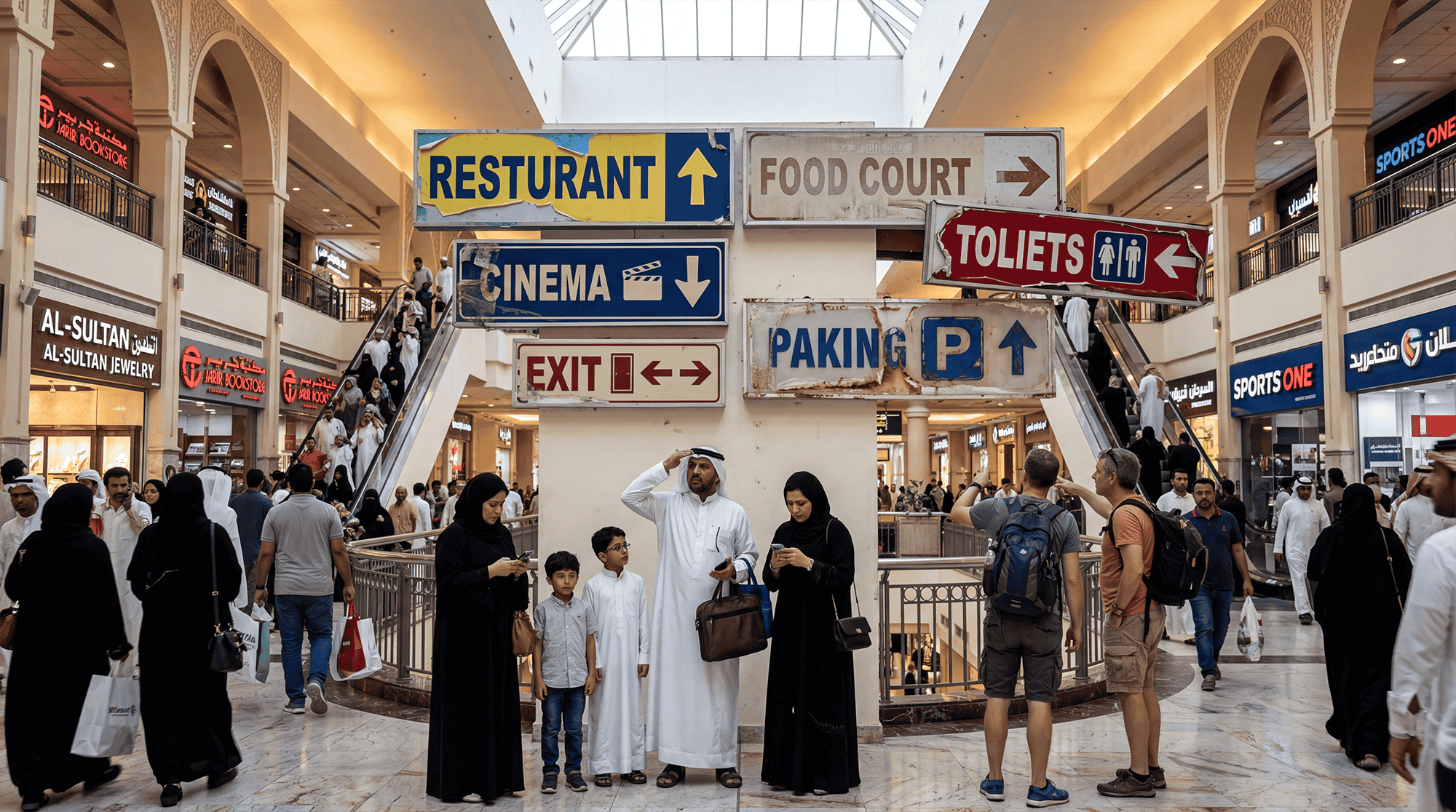
In wayfinding and placemaking, the consultant you choose determines the outcome you get — and the wrong choice costs far more than the fee you saved.
Here’s a story we’ve encountered more times than we’d like to admit. A developer invests hundreds of millions into a landmark mixed-use destination. Architecture: world-class. Landscape: stunning. Interior finishes: impeccable. Then, three months before opening, someone raises the question of wayfinding. The procurement department sends out a tender. The lowest bidder wins. Six months after launch, the entire signage system needs replacing because visitors can’t navigate the space, tenants are complaining about foot traffic, and the development’s carefully crafted brand is being undermined by every confused visitor posting their frustration online.
The development didn’t have a signage problem. It had a partner selection problem. And the cost of that mistake will far exceed whatever was “saved” in the procurement process.
The Expertise Gap That Nobody Talks About
Wayfinding is a discipline that doesn’t require a formal degree. This reality, uncomfortable as it is, means the market is populated by operators ranging from genuinely experienced strategic consultancies to sign fabricators who have adopted the language of experience design without possessing the underlying expertise. The consequences for clients who cannot distinguish between the two are severe and expensive.
A qualified wayfinding consultancy brings together semiotics, cognitive psychology, information design, spatial analysis, brand strategy, materiality science, and deep understanding of human behaviour in built environments. This multidisciplinary capability is what separates strategic wayfinding — the kind that drives commercial performance — from decorative signage that looks professional in renders but fails comprehensively in practice.
The distinction matters because the consequences of getting it wrong are not immediately visible. A poorly designed wayfinding system doesn’t announce itself on opening day. Its damage accumulates gradually through confused visitors who don’t return, through tenants whose locations remain undiscovered, through staff who spend increasing portions of their day giving directions instead of delivering service. By the time the problem becomes undeniable, the remediation costs have multiplied.
The False Economy of the Lowest Bid
Clients consistently tell us they want the best outcomes. Yet the procurement process frequently rewards the lowest price, operating under the assumption that wayfinding is a commodity service where one provider is functionally interchangeable with another. This assumption is fundamentally flawed, and the evidence is overwhelming.
When an inexperienced provider wins on price, the typical trajectory unfolds in predictable stages. Initial design work lacks strategic foundation — signage is conceived as a standalone exercise disconnected from the broader visitor journey, brand narrative, and spatial logic of the development. Production specifications may underestimate the demands of regional conditions, selecting materials that degrade rapidly under extreme heat, UV exposure, and sand abrasion. Information architecture reflects the provider’s understanding of the space rather than evidence-based analysis of how visitors actually move and make decisions.
The result is a system that requires remediation almost immediately — and remediation is always more expensive than doing it correctly the first time. We’ve seen projects where the cost of redesigning and replacing failed wayfinding systems exceeded the original project budget by 40% or more. When you add the reputational damage sustained during the period of visitor confusion, the intangible costs dwarf even the direct financial losses.
What Poor Advice Actually Costs
The damage from selecting the wrong partner extends well beyond the signage itself. Poor strategic advice at the outset creates cascading failures that ripple through the entire visitor experience.
No strategy means no coherence. Signage without wayfinding strategy is like constructing a building without architectural drawings. The individual elements may be competently executed, but without a unifying spatial logic, the system fails to function as an integrated whole. Visitors encounter contradictory information, inconsistent visual language, and navigation dead-ends that no amount of additional signage can resolve. As one leading practitioner has observed, adding more signs to a confusing environment typically makes things worse, not better, because the problem isn’t insufficient signage — it’s insufficient thinking.
Poor design inflates production costs. Inexperienced providers frequently underestimate the complexity of producing wayfinding systems for large-scale developments. Design decisions made without understanding fabrication constraints, installation requirements, or maintenance implications lead to change orders, production delays, and cost escalations that erode whatever savings the lower fee initially promised. We’ve witnessed projects where poorly specified materials required complete replacement within the first year, effectively doubling the total expenditure.
Abortive work becomes the norm. When wayfinding is treated as an afterthought rather than integrated into the development process from early design stages, the risk of abortive work increases dramatically. Signage designed and fabricated based on preliminary spatial plans that subsequently evolve — tenant configurations that change, circulation patterns that are reorganised, naming conventions that are revised — becomes expensive waste. Strategic partners understand these dependencies and sequence their work accordingly. Inexperienced providers typically don’t, and the client pays for the education.
The Procurement Paradox
There is a fundamental disconnect at the heart of how wayfinding services are typically procured. If you needed cardiac surgery, your first question wouldn’t be “who offers the cheapest rate?” You would evaluate expertise, track record, reputation, and the surgeon’s ability to navigate complexity. Yet procurement departments routinely reduce wayfinding consultancy to a line-item comparison where the richness of experience, the depth of strategic capability, and the quality of past outcomes become secondary to unit cost.
This isn’t about advocating for higher fees for their own sake. It’s about recognising that the expertise required to create wayfinding systems that genuinely drive commercial performance — systems that increase dwell time by 23%, improve conversion rates by 15%, and extend exploration by 40% — represents years of accumulated knowledge that simply cannot be replicated by providers competing primarily on price.
The procurement process itself often becomes an obstacle. Cumbersome, form-driven tender processes that prioritise administrative compliance over professional dialogue make it difficult for clients to assess what truly matters: whether a potential partner understands visitor psychology, regional environmental challenges, brand integration, and the complex interdependencies between spatial design and commercial performance. When expertise isn’t valued at procurement time, it cannot be expressed during the project lifecycle.
What to Look For in a Strategic Partner
Selecting the right wayfinding and placemaking partner requires evaluating capabilities that go far beyond portfolio aesthetics. The critical differentiators between strategic consultancies and sign designers become apparent when you examine how they approach three fundamental questions.
First, do they lead with strategy or design? A strategic partner will begin by understanding how your development works as a system — mapping natural movement patterns, analysing decision points, identifying where spatial logic supports or undermines the visitor journey. A sign designer will begin by asking what font you prefer. The distinction sounds simple, but it determines everything that follows.
Second, do they understand your region? The Middle East’s extreme climate, multilingual populations, cultural considerations, and distinctive development typologies require specialised knowledge that cannot be improvised. International firms without regional experience regularly underestimate the impact of thermal comfort on pedestrian behaviour, the complexities of Arabic-English bilingual information hierarchy, or the cultural patterns that influence how different demographics navigate public space.
Third, do they measure outcomes? Strategic partners define success metrics before design begins and track performance after implementation. They understand that wayfinding is not a deliverable but an ongoing system that requires monitoring, refinement, and evolution. Providers focused primarily on fabrication and installation consider the job complete when the last sign is mounted. The difference in long-term asset value between these two approaches is enormous.
The Partnership Investment
At Creative Dialog, with over 25 years of guiding visitor experience across the Middle East’s most ambitious developments, we’ve learned that the partner-client relationship in wayfinding is genuinely unlike any other consultancy engagement. The outcomes are visible to every single person who enters a space. The consequences of failure are public and persistent. And the value of getting it right compounds over the entire lifespan of a development.
Choosing the right partner isn’t an expense. It’s the most important investment decision in your visitor experience strategy. Because in wayfinding, as in architecture and medicine and every other discipline where expertise truly matters, you don’t get what you pay for — you get what you select for.
Like What Your Reading?
These articles are a small part of our research and strategic advisory Services. Get in touch with Creative Dialog today to see how we can distill these insights into actionable strategies and solutions to improve the visitor experience across your destination.
Looking for deeper analysis of the Visitor Experience economy?
Read more over at Extended Dialog.