

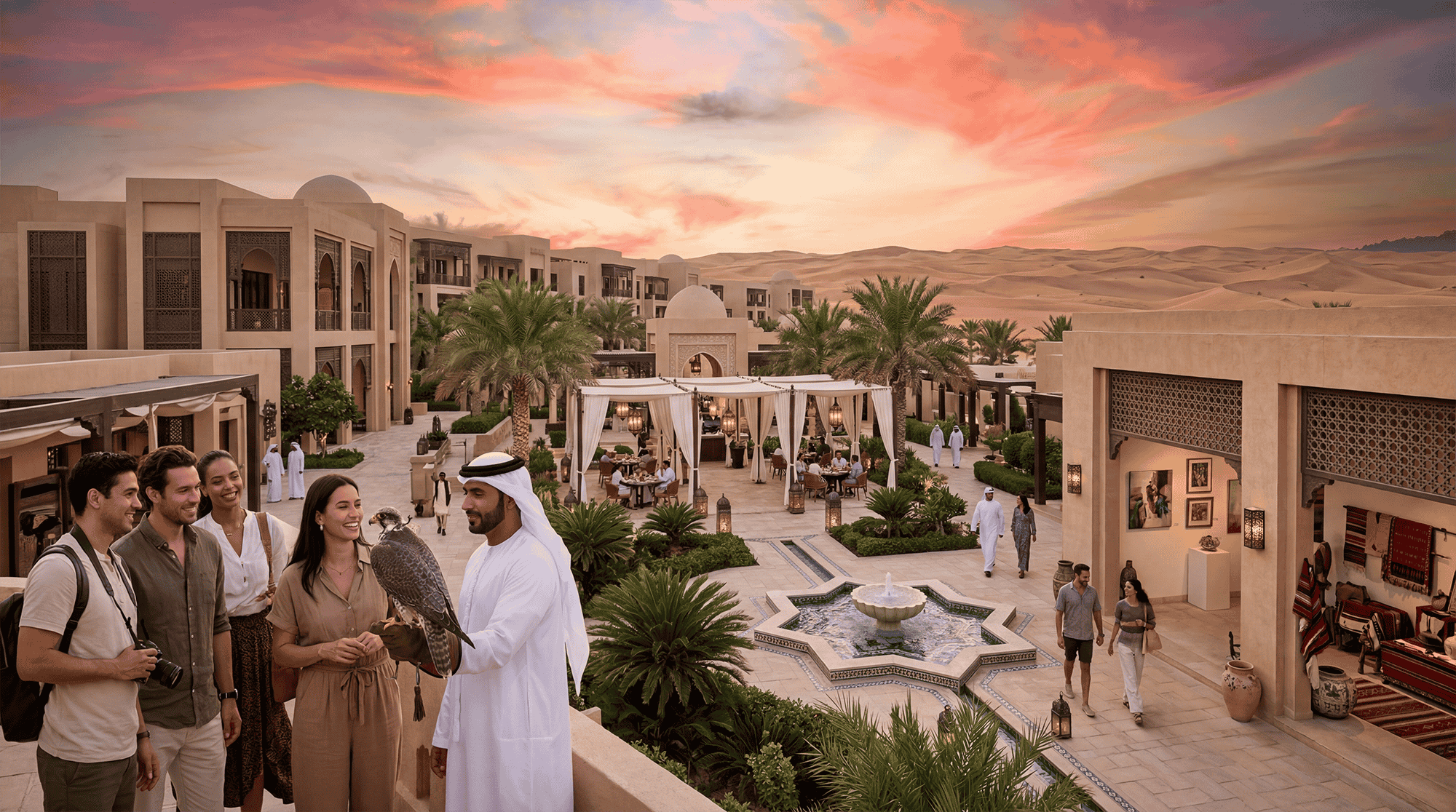
Why building world-class destinations is no longer enough — and what the region's developers need to do differently.
The Middle East is investing at a scale the world has never seen. But as global competition for visitor attention intensifies, the question is no longer what gets built — it's what people feel when they arrive. The destinations winning the experience economy aren't the biggest or the most spectacular. They're the ones that understand people.
The experience economy isn’t a theory anymore. It’s a $3 trillion reality. McKinsey’s analysis of the global tours, activities, and attractions market puts its total value above that figure, with destination visitors alone accounting for between $1.1 and $1.3 trillion in annual experience spending. The growth trajectory is equally striking — experts estimate growth in the experiences segment exceeding 14% per year.
For Middle Eastern destinations navigating an intensely competitive development landscape, these numbers represent both opportunity and warning. The opportunity: a massive and growing market where the region’s natural advantages — cultural depth, hospitality heritage, climate-driven innovation, capital availability — create genuine competitive edge. The warning: capturing this market requires fundamentally different thinking than the build-and-they-will-come approach that characterised the region’s earlier development waves.
What the Data Actually Tells Us
Before we talk about what destinations should do, it’s worth understanding what’s driving visitor behaviour globally.
A 2024 Travel Experience Trend Tracker found that 98% of travellers said experiences are very or extremely important when choosing a destination. Not accommodation quality. Not flight connections. Not price. Experiences. They’re the primary driver of where people decide to go and how long they stay.
The spending behaviour reinforces this. Deloitte’s global data confirms that in-destination experiences are among the areas where consumers are least willing to cut spending — travellers are more likely to economise on flights or accommodation than on activities they want to do. This resilience makes experience-oriented destinations more insulated from economic headwinds than those competing purely on accommodation or retail.
The generational shift is particularly relevant for the Middle East’s youth-heavy demographic profile. McKinsey survey data shows 52% of Gen Z travellers splurge on experiences, compared with 29% of baby boomers, with Gen Z more willing to economise on flights, transport, shopping, and food before trimming experience spending.
Arival’s research adds granularity: US travellers booked an average of 4.7 tours and activities per trip in 2023, up from 2.7 in 2019. That’s a 74% increase in experience consumption per trip in just four years.
Five Lessons from the World’s Best Experience Destinations
So what separates destinations that are capturing this shift from those watching it pass them by? After studying global benchmarks and working across the Gulf, several patterns emerge.
Lesson 1: Experiences Aren’t Additions — They’re the Product
The most common mistake in Middle Eastern destination development is treating experiences as amenities — things you add to a development after the buildings are designed, the way you add a gym or a swimming pool. The world’s best experience destinations reverse this hierarchy entirely. The experience is the product. Everything else — architecture, infrastructure, technology — exists to support it.
This means experience strategy must inform design, not follow it. When a visitor’s emotional journey through a space is the primary design consideration, fundamentally different decisions get made about spatial sequence, transition design, sightline management, lighting, acoustics, and programming infrastructure. These decisions can’t be retrofitted.
Lesson 2: Authenticity Isn’t Optional — It’s the Only Viable Strategy
McKinsey’s conversations with experience providers revealed that authenticity and local engagement consistently rank among the most crucial components of great experiences — visitors appreciate thoughtfully crafted encounters that bring a specific locale to life.
This finding has particular resonance in the Gulf, where the temptation to import proven concepts from other markets remains strong. A Dubai version of a Tokyo experience or a Riyadh version of a Barcelona street festival will always feel like a copy — because it is. The destinations capturing premium experience spend are those that facilitate encounters with genuine local identity: the culinary traditions, the hospitality customs, the environmental adaptations, the craft practices, and the contemporary creative expressions that are authentically of this place.
Lesson 3: Discovery Must Be Designed, Not Left to Chance
The best experience destinations don’t just offer experiences — they design the process of discovering them. This is where wayfinding, placemaking, and experience design converge. The journey between experiences matters as much as the experiences themselves.
Consider how Tokyo’s neighbourhoods reveal themselves gradually through layered discovery — each turn producing something unexpected. Or how Copenhagen’s waterfront creates a continuous sequence of experiential moments that draws visitors forward. These aren’t accidents. They’re the result of deliberate design that treats the visitor’s path through space as a narrative with pacing, surprise, and resolution.
In the Middle East, where climate constraints concentrate pedestrian activity into specific corridors and timeframes, this design discipline is even more critical. The limited walkable moments must be rich enough to sustain discovery and generate the emotional connections that drive return visits and recommendations.
Lesson 4: The Physical-Digital Interface Creates New Possibilities
McKinsey’s research notes that 47% of experience bookings still happen offline, through walk-ups, hotel concierges, and traditional channels. This means the physical environment remains the primary discovery platform for experiences — making spatial design, wayfinding, and placemaking central to experience economy performance.
But the integration of digital tools is creating new possibilities. Destinations that layer digital discovery onto physical environments — through contextual content, personalised recommendations, and seamless booking at the point of inspiration — capture impulse engagement that would otherwise be lost. The key is integration rather than substitution: technology that enhances the physical experience rather than replacing it.
Lesson 5: Measure What Drives Return, Not Just What Drives Arrival
Most destination measurement frameworks focus on acquisition metrics — visitor numbers, arrival statistics, hotel occupancy. These tell you how many people came but nothing about whether they’ll come back. In the experience economy, return visitation and advocacy are the metrics that predict long-term success.
Our research consistently confirms that visitor satisfaction drives revisit intention, and that experience quality is the strongest predictor of satisfaction. This means destinations serious about competing in the experience economy need to measure experience quality systematically — through Net Promoter Scores, dwell time analysis, discovery rates, social sharing behaviour, and qualitative experience auditing — and use these metrics to drive continuous improvement.
The Middle Eastern Opportunity
The Gulf’s position in the experience economy is stronger than many operators realise, but it’s not guaranteed. The region’s advantages are real: cultural depth, hospitality heritage that predates the tourism industry by centuries, climate challenges that have driven genuine innovation in environmental design, and capital resources that enable ambitious experiential investment.
But these advantages only convert into market position when destinations commit to experience-led development — designing from the visitor’s emotional journey outward rather than from the building programme inward. The developments that make this commitment will find a market that’s larger, faster-growing, and more resilient than traditional real estate metrics alone would suggest. Those that don’t will continue competing on specifications in a market that’s increasingly buying stories.
Like What Your Reading?
These articles are a small part of our research and strategic advisory Services. Get in touch with Creative Dialog today to see how we can distill these insights into actionable strategies and solutions to improve the visitor experience across your destination.
Looking for deeper analysis of the Visitor Experience economy?
Read more over at Extended Dialog.