

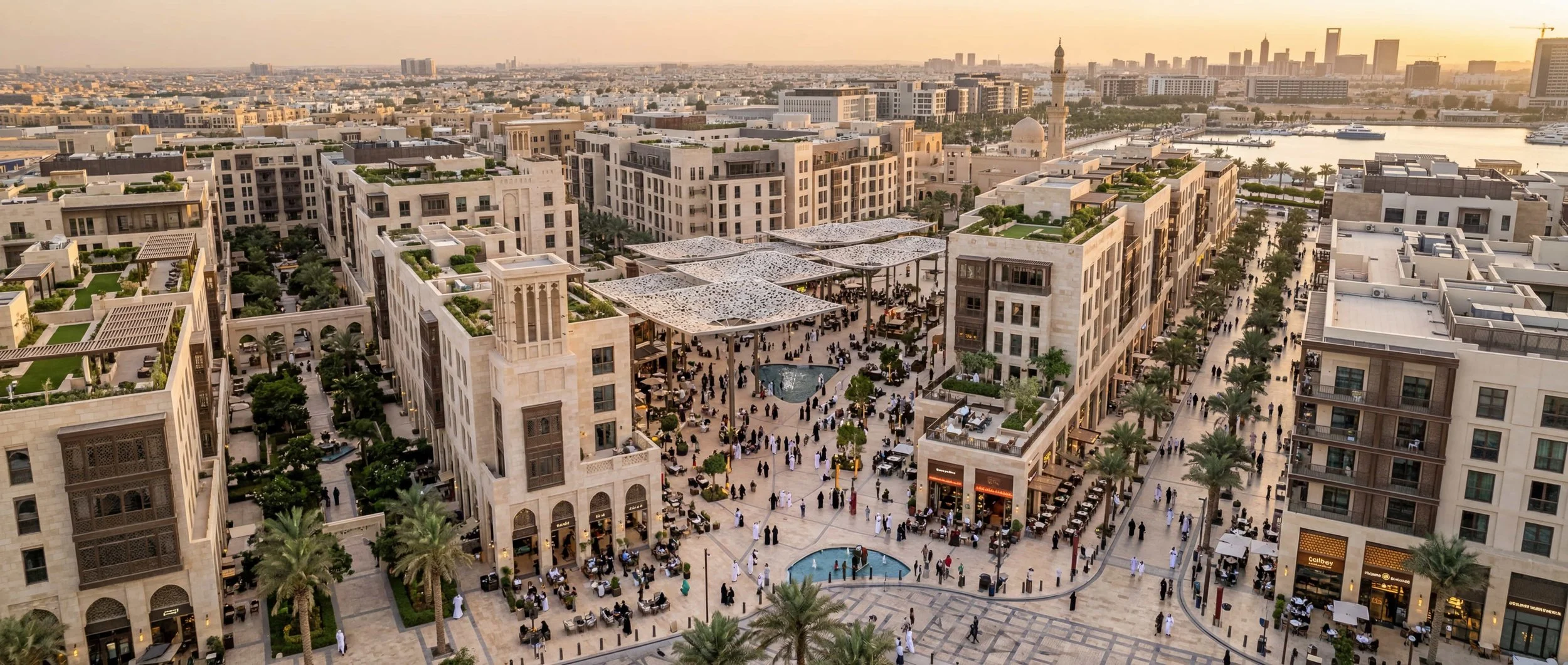
Why building world-class destinations is no longer enough — and what the region's developers need to do differently.
Consider two numbers. Office buildings surrounding Bryant Park in Manhattan command rents 12.5 per cent above the Midtown average, generating an additional $33 million in annual tax revenue for New York City. At Pearl Street Triangle in DUMBO, the conversion of a parking area into a pedestrian plaza drove a 172 per cent increase in local retail sales.
Now consider a third data point: Hudson Yards – $25 billion of capital deployed across fourteen acres – which the New York Times critic Michael Kimmelman dismissed as 'a relic of dated 2000s thinking, nearly devoid of urban design'. The variable separating outsized commercial returns from expensive disappointment is a placemaking strategy. Not a landscape plan. Not an events calendar. A structured, commercially grounded framework that connects design decisions to human behaviour and, ultimately, to financial performance.
What placemaking strategy actually means.
The term has been diluted through overuse. Architects claim it. Event producers claim it. Branding agencies claim it. Some wayfinding practitioners attempt to claim it.
In practice, a placemaking strategy is a strategic framework that traces a clear causal chain: physical design decisions shape human outcomes – dwell time, movement patterns, emotional attachment, repeat visitation – and those human outcomes drive measurable financial returns: rental premiums, land-value uplift, reduced vacancy, accelerated absorption.
Clarity demands that the discipline define what it is not.
Landscape architecture is a vital contributor, but it is not a placemaking strategy on its own. A beautifully planted public realm without a programming framework, an audience model, or a performance measurement system is decoration, not strategy.
Event activation generates footfall, yet it cannot substitute for the underlying spatial logic. A calendar of pop-ups layered onto a poorly configured ground plane will not correct fundamental movement or connectivity failures.
Public art procurement adds cultural texture but does not constitute a place narrative. Commissioning sculpture without an identity framework risks producing installations that are technically accomplished and emotionally inert.
Community engagement is ethically essential, yet on its own it produces consultation reports, not investable direction. Engagement without commercial framing leaves developers with sentiment data and no decision architecture.
Signage and wayfinding solve orientation problems, but orientation is not experience. A visitor who can find the café but has no reason to linger has been directed, not engaged.
A more realistic three-element model – placemaking, place branding, and place management – is a useful taxonomy for organising these disciplines. It correctly identifies that physical intervention, narrative identity, and operational stewardship must work in concert. Where it falls short is in foregrounding the commercial return loop that developers require: the explicit connection between placemaking investment and asset-level financial performance.
Similarly, the Project for Public Spaces definition – 'a participatory process for shaping public space that harnesses the ideas and assets of the people who use it' – remains valuable for its emphasis on community-led processes, but it was conceived for civic contexts and lacks the commercial framing a development board needs to approve capital expenditure.
The commercial case for placemaking strategy
The evidence base is no longer anecdotal; it is actuarial.
King's Cross in London is the benchmark transformation. The UK Government sold its stake in the 67-acre development for £371 million. Google subsequently committed £1 billion for its new headquarters on the site. That progression – from derelict rail lands to one of Europe's most consequential mixed-use destinations – followed a fifteen-year placemaking framework that prioritised public realm, cultural programming, and narrative identity long before the commercial buildings were occupied.
New York's High Line demonstrates the multiplier effect at its most dramatic. A $115 million public investment in an abandoned elevated railway has generated over $5 billion in new development and economic activity – a return ratio exceeding 43:1. Residential property values within the park's immediate catchment increased by approximately 32 per cent. The mechanism is not mysterious: a distinctive, well-managed public experience increased demand for adjacency, and that demand repriced every surrounding parcel.
The contrast with Hudson Yards is instructive, not because the project has failed commercially in absolute terms, but because it demonstrates what capital alone cannot purchase. Despite $25 billion in investment and contributions from globally prominent architects, the development has struggled to generate the civic affection and cultural distinctiveness that sustain long-term place value.
Savills research confirms the pattern at portfolio scale. Well-executed placemaking delivers an average 25 per cent uplift in surrounding land values. At Accordia in Cambridge, a masterplan that prioritised public realm quality over unit density achieved a 37 per cent sales premium against local comparables.
In the Gulf, Yas Island provides the destination-scale evidence. Under Miral's stewardship, the island recorded more than 38 million visits in 2024 – a 10 per cent annual increase – with hotel occupancy peaking at 90 per cent. That performance reflects a deliberate placemaking strategy: integrated destination management combining attractions, activations, urban renewal, hospitality, events, and brand coherence.
Eight deliverables a developer should expect.
A credible placemaking strategy produces tangible outputs, not abstract principles. The following eight deliverables represent the minimum scope.
A place audit establishes the existing condition – physical, social, cultural, and competitive – against which all subsequent decisions are calibrated. It identifies latent assets and structural constraints before design teams begin drawing.
Stakeholder vision alignment brings investors, operators, public authorities, and community representatives to a shared definition of success. Without this, design briefs fragment and approvals stall.
Audience profiling moves beyond demographics to behavioural segmentation: who will use this place, when, for what purpose, and what will compel them to return. This is the demand-side intelligence that spatial programming depends on.
Spatial programming translates audience insight into a ground-plane plan: the mix, sequence, and adjacency of uses that generate dwell time, social interaction, and commercial transaction. It is the bridge between strategic intent and architectural brief.
An identity and narrative framework defines what the place means – its story, its cultural positioning, its emotional register – so that every subsequent design and communication decision reinforces a coherent whole. This is not a logo exercise; it is a strategic narrative that shapes everything from material palettes to tenanting criteria.
An activation strategy sets out the phased programme of events, installations, and operational interventions that bring the place to life from day one and sustain it through seasonal and market cycles. Critically, it plans for the difficult early years when footfall has not yet reached critical mass.
Wayfinding integration ensures that orientation, movement, and discovery are designed as a single experience system rather than bolted on after the architecture is fixed. At Creative Dialog, this integration of: wayfinding with placemaking and destination branding is central to the work – and it is what distinguishes an integrated approach from competitors who deliver only one discipline.
Performance metrics define the KPIs – footfall, dwell time, sentiment, conversion, rental velocity, NPS – against which the strategy's success will be measured and iteratively refined.
Why timing determines everything.
A placemaking strategy commissioned after concept design is remedial. One commissioned at RIBA Stage 0 – Strategic Definition – is foundational.
The distinction is not procedural; it is financial. As Phil Myrick, former CEO of Project for Public Spaces, has observed: 'No architect would start designing a building without first having the building program clearly defined, and yet many design projects for parks and public spaces proceed without having the program in place first.' When placemaking logic is introduced after massing and floor plates have been fixed, the cost of correction escalates sharply. Research published in the Civil Engineering Journal (2019) documents design-change-driven cost overruns of between 5 and 40 per cent on major projects.
Early integration does not slow the programme; it compresses the rework cycle. A spatial programme informed by audience data and activation requirements reduces downstream value engineering, minimises planning risk, and gives leasing teams a credible story months earlier than a design-first process allows. The transformation from static design thinking to dynamic place strategy begins here.
What happens without a strategy?
Without a placemaking strategy, developments generate confusion rather than confidence, generic character rather than distinctive identity, transactional relationships rather than emotional attachment. Tenants pay asking rent but feel no loyalty. Visitors attend but do not return. The public realm looks maintained but feels uninhabited. Over a ten-year hold period, the compounding cost of that indifference is measured in basis points of yield compression that never materialise, in leasing velocity that underperforms projection, in brand equity that remains unrealised.
The projects that outperform – Bryant Park, King's Cross, the High Line, Yas Island – share one structural advantage: they treated placemaking strategy as a capital investment, not an amenity budget line. The returns speak for themselves.
For developers commissioning placemaking strategy in the Gulf or Southeast Asia, Creative Dialog brings integrated wayfinding, placemaking, and destination branding expertise across 200+ GCC projects. You can even book a discovery session to find out more.
Like What Your Reading?
These articles are a small part of our research and strategic advisory Services. Get in touch with Creative Dialog today to see how we can distill these insights into actionable strategies and solutions to improve the visitor experience across your destination.
Looking for deeper analysis of the Visitor Experience economy?
Read more over at Extended Dialog.