

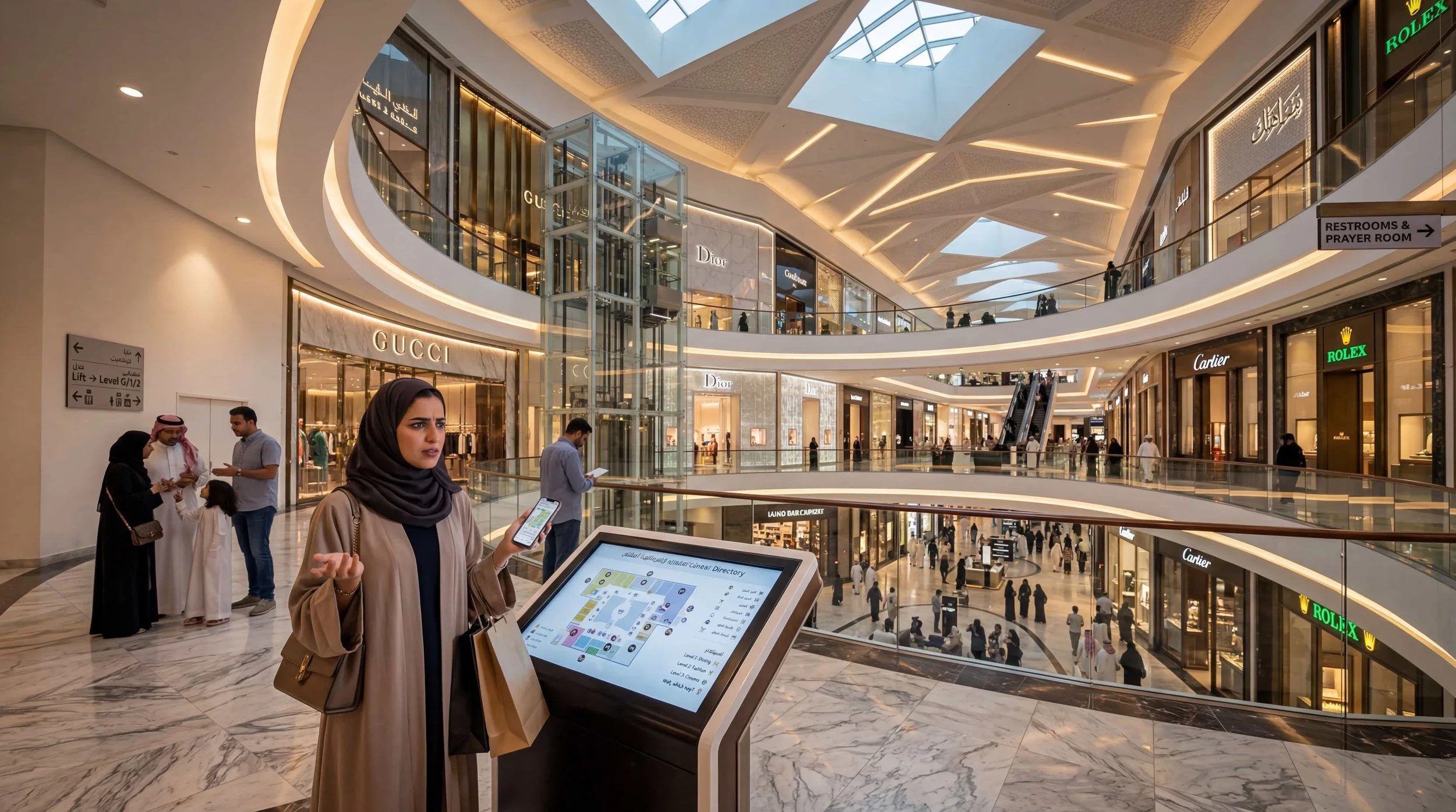
How silent wayfinding and navigation issues can be highly damaging to retail destinations.
The most dangerous wayfinding problems are the ones nobody reports. Visitors don't typically fill out complaint cards about confusing navigation — they simply leave earlier than they intended, skip the upper floors, default to the same familiar route, and mention to friends that the place "felt overwhelming" without articulating exactly why. Asset managers rarely see these signals in their standard reporting because wayfinding failures don't register as wayfinding failures. They register as underperforming zones, declining dwell times, and tenant complaints about foot traffic that never seem to have a clear cause.
After sixteen years of diagnosing navigation problems across retail destinations throughout the Middle East — work that accounts for the significant majority of our practice — we've found that the warning signs follow consistent patterns. Recognising them is the first step toward addressing what is often one of the most cost-effective interventions available to retail asset owners.
1. Visitors Cluster in the Same Areas While Entire Zones Sit Quiet
Walk through your destination at peak hours and observe where people concentrate. In most retail environments with wayfinding problems, visitor density follows a predictable pattern: heavy clustering near main entrances, anchor tenants, and ground-floor corridors, with dramatic drop-offs in upper levels, secondary wings, and any area that requires a deliberate navigation decision to reach.
This isn't simply a tenanting problem. It's a legibility problem. Visitors gravitate toward what they can see and understand from their current position. When the path to secondary areas requires interpreting unfamiliar signage, navigating ambiguous junctions, or trusting that a corridor leads somewhere worthwhile, most visitors — particularly first-time visitors and tourists — default to the path of least cognitive effort. They stay where they are.
The commercial impact compounds across every tenant in those underperforming zones. Rental yields decline. Leasing conversations become difficult. The development creates a two-tier economy where prime locations command premiums not because they offer better space, but because the wayfinding system fails to make secondary locations genuinely accessible.
If your heat maps show persistent dead zones adjacent to viable tenant spaces, your wayfinding system is almost certainly a contributing factor.
2. The Information Desk Is Your Busiest Attraction
Information desks serve an important hospitality function, but their volume of directional enquiries is also one of the clearest diagnostic indicators available. When visitors consistently need human assistance to navigate a built environment, the environment itself is failing to communicate.
Track the nature of the questions being asked. If the majority relate to basic orientation — "Where is the food court?" "How do I get to the cinema?" "Which level is parking?" — these are questions the spatial environment and wayfinding system should be answering before visitors need to ask. Every one of these enquiries represents a moment of confusion that preceded it, a period of wandering that consumed time and patience, and a visitor whose experience has already been diminished before they reach their destination.
In Middle Eastern retail environments, where the visitor demographic spans dozens of nationalities and languages, the information desk becomes an even more revealing indicator. If particular demographic groups are disproportionately represented in enquiry volumes, this often signals that the wayfinding system is failing specific audiences — whether through language limitations, cultural assumptions about spatial communication, or sign placement that doesn't account for different navigation approaches.
3. Your Signage Has Been Added To, Not Designed
This is one of the most visible symptoms and one of the most commonly overlooked. Walk through your destination and look at the signage — not the original suite installed at opening, but everything that has been added since. Temporary directional signs taped to walls. A-frame boards redirecting traffic around construction. Handwritten arrows near lift lobbies. Stickers on glass pointing toward relocated tenants. Additional hanging signs installed because the original ones weren't working.
Each of these additions represents a specific moment when someone recognised a navigation problem and reached for the quickest available solution. The result, accumulated over months and years, is a visual environment that has become progressively more cluttered and less coherent — the opposite of what effective wayfinding achieves.
This pattern is particularly common in destinations that have undergone expansion or significant tenant turnover. The original wayfinding system was designed for an opening-day configuration that no longer exists, and rather than rethinking the strategy, the response has been to layer additional signage onto a framework that was never designed to accommodate it.
If your signage environment has grown by addition rather than by design, the system has almost certainly passed the point where incremental fixes can address the underlying problem.
4. Visitors Use Their Phones to Navigate Your Building
Observe visitors at decision points — junctions, lift lobbies, escalator landings, transitions between zones. If a noticeable proportion are consulting their phones for orientation rather than looking at the environment around them, your spatial navigation is not doing its job.
This behaviour is often misread as a generational preference. It isn't. When visitors reach for their phones in a built environment, they're not choosing digital over physical — they're signalling that the physical environment has failed to provide the information they need in a format they can use. In a well-designed wayfinding environment, visitors navigate intuitively through a combination of sightlines, spatial logic, environmental cues, and strategically placed information. They don't need to open Google Maps to find the restaurant district.
The implications extend beyond visitor experience. When navigation shifts to personal devices, the development loses control of the journey. The visitor's path becomes optimised for efficiency rather than discovery — a direct line from A to B that bypasses everything in between. The serendipitous encounters with new tenants, the exposure to complementary offerings, the browsing behaviour that drives secondary spending — all of it diminishes when visitors outsource their navigation to an algorithm that knows nothing about your tenant mix.
5. Tenants in Secondary Locations Consistently Underperform
When leasing managers encounter persistent underperformance in specific zones, the first instinct is usually to attribute it to the tenant mix, the category, or the location itself. Sometimes those explanations are accurate. But when the pattern recurs across different tenants, different categories, and different lease periods — when good operators consistently struggle in the same locations — the common factor isn't the tenant. It's the environment.
Wayfinding failures create self-reinforcing cycles in tenant performance. Poor navigation reduces foot traffic to certain areas. Reduced foot traffic diminishes sales. Diminished sales lead to tenant turnover. Turnover creates vacancies that further reduce reasons for visitors to venture into those areas. The cycle accelerates, and the zones in question develop reputations within the leasing community as "difficult locations" — a perception that becomes progressively harder to reverse.
The diagnostic question is straightforward: can a first-time visitor find these underperforming locations without assistance, and do they have a reason to discover them during a normal visit? If the answer to either question is no, wayfinding is a contributing factor in the performance gap — and likely a more significant one than the tenanting decisions being scrutinised.
6. Your Car Park Experience Contradicts Your Retail Experience
The visitor journey doesn't begin at the mall entrance — it begins at the car park entry barrier. Yet parking navigation is routinely treated as separate from the retail wayfinding system, often designed by a different team, at a different time, using different visual language and information design principles.
The result is a jarring disconnect. A visitor navigates a dim, confusing car park with generic signage, manages to find a space, then walks through a transition zone that offers minimal orientation to the retail environment above. By the time they emerge onto the retail floor, they've already consumed a portion of their patience and goodwill on an experience that communicated nothing about the quality of what awaits them.
In Middle Eastern retail destinations, where the overwhelming majority of visitors arrive by car and where summer temperatures make the parking-to-retail transition a critical comfort moment, this disconnect is particularly damaging. The car park experience sets the emotional baseline for the entire visit. If that baseline is frustration and disorientation, the retail environment has to work significantly harder to recover the visitor's mood — and the data consistently shows that many visitors never fully recover.
Assess whether a first-time visitor can park, orient themselves, and reach the retail environment feeling informed and comfortable. If the honest answer is no, the car park wayfinding is actively undermining the retail experience above it.
7. Your Wayfinding Hasn't Changed Since Opening Day
Retail destinations are living environments. Tenants change. Zones are repurposed. Extensions open. Visitor demographics shift. Usage patterns evolve as a destination matures from novelty to routine. Yet the wayfinding system in many developments remains frozen at the configuration it had on opening day — designed for a tenant mix, a visitor profile, and a spatial layout that may no longer exist.
This is perhaps the most fundamental diagnostic indicator. If your wayfinding strategy has not been formally reviewed and updated since the destination opened, it is almost certainly misaligned with the current reality. This doesn't necessarily mean the signage needs replacing. It means the underlying strategy — the hierarchy of information, the decision-point logic, the journey sequences, the balance between direction and discovery — needs reassessing against how the destination actually functions today rather than how it was envisioned at concept stage.
The most effective retail wayfinding programmes build periodic strategic review into their operational calendar. Not sign maintenance — strategic review. An assessment of whether the navigation logic still serves the current tenant configuration, visitor profile, and commercial objectives. This kind of review typically costs a fraction of the capital spent on the original wayfinding system and frequently identifies opportunities that deliver measurable returns in foot traffic distribution, dwell time, and tenant satisfaction.
What Comes Next?
If three or more of these signals are present in your destination, the wayfinding system warrants a formal diagnostic review — not a signage audit (which examines whether existing signs are visible and accurate) but a strategic assessment of whether the navigation experience serves the destination's current commercial objectives.
This distinction matters. Sign audits fix symptoms. Strategic diagnostics address causes. The difference between the two determines whether the next investment in wayfinding delivers lasting improvement or simply adds another layer of signage onto a system that isn't working.
The good news is that wayfinding remediation is one of the highest-return interventions available to retail asset owners. The improvements in visitor flow, tenant performance, and dwell time that follow a strategic wayfinding overhaul are measurable, often within the first quarter of implementation. The destinations that treat navigation as strategic infrastructure — reviewed, maintained, and evolved with the same attention given to tenanting and marketing — are the ones whose visitors stay longer, spend more, and return more often.
The ones that don't are the ones whose visitors simply leave.
Like What Your Reading?
These articles are a small part of our research and strategic advisory Services. Get in touch with Creative Dialog today to see how we can distill these insights into actionable strategies and solutions to improve the visitor experience across your destination.
Looking for deeper analysis of the Visitor Experience economy?
Read more over at Extended Dialog.