

Five Critical Questions to Answer Before Your Next Placemaking Project Breaks Ground.
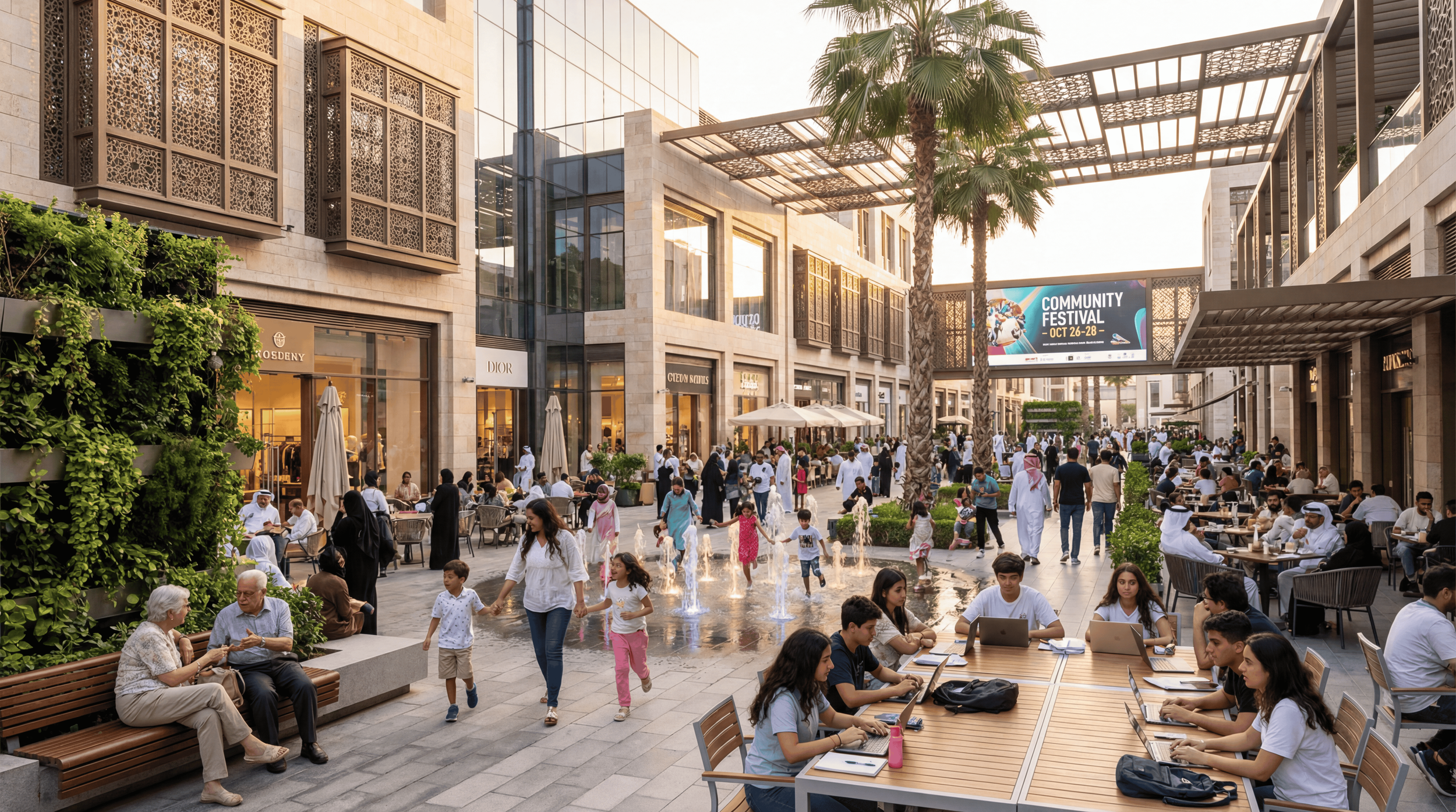
Why Place Matters More Than Ever.
Undertaking a placemaking programme is one of the most consequential investments a developer can make.
Done well, it transforms underutilised space into a vibrant community asset that commands premium values, attracts quality tenants, and builds lasting brand equity. Done poorly, it becomes a cautionary tale — an expensive monument to good intentions and inadequate planning.
The difference between those two outcomes is almost never a matter of budget. It is a matter of strategic preparation.
Across our fifteen years of practice in the Middle East, we’ve observed a consistent pattern: projects that invest properly in the planning phase — in understanding context, engaging communities, and establishing clear strategic foundations — achieve 73% higher user satisfaction and generate 2.4 times more foot traffic than traditionally developed spaces. Those metrics translate directly into commercial performance and sustained community value.
The projects that struggle?
They rushed past the questions that matter most. Here are the five we insist every client answers before a single line is drawn.
The Five Questions That Define Placemaking Success
1. Have You Listened Before You Designed?
The most common mistake in placemaking is falling in love with renders before you’ve spoken to the people who will actually use the space. Community engagement is not a compliance exercise — it is the single most reliable way to identify opportunities that desk research will never reveal, and to build the stakeholder support that sustains a project through delivery and beyond.
Effective engagement goes far beyond a public consultation session and a feedback form. It requires structured methodologies that reach diverse demographic groups, translate qualitative feedback into actionable design criteria, and demonstrate transparently how community input shapes outcomes.
At Creative Dialog, our Creative Intelligence programmes provide this structure. We design engagement processes that capture the voices of residents, businesses, cultural stakeholders, and future users — then synthesise those perspectives into strategic planning documents that give our clients genuine confidence in their direction. The result is not just better design; it is a project that arrives with built-in community advocacy rather than opposition.
In the Middle East, where developments routinely serve communities of 150+ nationalities, this engagement work demands particular cultural sensitivity. Understanding whose voices are represented — and whose are missing — is as important as the feedback itself.
2. Do You Truly Understand Your Site’s Context?
Every place carries its own identity — layers of history, culture, environmental character, and social pattern that existed long before any development brief was written. Placemaking that ignores this context produces generic spaces. Placemaking that honours it produces places with soul
Comprehensive contextual analysis examines multiple dimensions: historical land use patterns and cultural significance, existing movement patterns and desire lines, demographic composition and behavioural data, environmental conditions including microclimate factors, adjacent land uses and future development trajectories, and infrastructure capacity. This sits side by side with developing the site narrative based on the clients and the consumers project aspirations.
This analysis is not academic. It directly informs design decisions that determine whether a new intervention enhances or disrupts existing community patterns. In the Middle East specifically, contextual understanding must account for the region’s extreme climate conditions, its multilingual populations, and the cultural dynamics that shape how people inhabit public space — factors that generic international frameworks consistently underestimate.
We synthesise this work into strategic planning documents that become the decision-making backbone of the project. When difficult choices arise during design and delivery — and they always do — this contextual foundation ensures that trade-offs are made with full awareness of their implications.
3. Is Your Design Genuinely Inclusive?
Inclusive design is not a compliance checkbox. It is a commercial strategy. Spaces that welcome people of all ages, abilities, and backgrounds attract broader audiences, generate longer dwell times, and build the kind of community loyalty that drives sustained commercial performance.
In practice, this means designing multiple circulation routes that accommodate different mobility needs, varied seating options, multi-sensory wayfinding systems, flexible spaces adaptable to different cultural uses, and amenities that serve diverse age groups. In the Middle East, inclusive design must also account for cultural considerations around gender, family use patterns, prayer time requirements, and the expectations of both local and expatriate populations.
The research is clear: families utilise spaces longer when facilities accommodate all members. Corporate users choose venues where all participants can fully engage. These are not niche requirements — they represent the majority of your visitor base.
Our approach integrates inclusive design principles from the earliest strategic phase, ensuring accessibility is embedded in the DNA of the project rather than retrofitted as an afterthought. The difference in quality — and in visitor response — is immediately apparent.
4. Have You Embedded Sustainability From Day One?
Sustainability in placemaking has evolved from optional enhancement to fundamental requirement. Developers who treat it as a late-stage addition invariably produce compromised outcomes. Those who embed it from inception create places that perform better, cost less to maintain, and meet the expectations of increasingly environmentally conscious visitors and tenants this includes everything from materials choice to the judicious use of shade throughout a master plan.
Strategic sustainability encompasses material selection — utilising locally sourced, renewable, and recycled materials that reduce carbon footprint while often delivering superior durability in extreme climate conditions. It includes green infrastructure integration, energy-efficient systems, drought-tolerant landscaping, and waste reduction strategies that span the full project lifecycle.
Even wayfinding systems can contribute to a destination’s sustainability credentials. Eco-friendly signage solutions using recycled aluminium, sustainable substrates, and low-impact manufacturing processes demonstrate that environmental responsibility can be integrated into every element of the place experience without compromising functionality or aesthetics.
In the GCC, where extreme temperatures place extraordinary demands on materials and energy systems, sustainability is not just an ethical imperative — it is an operational one. Developments that get this right from the outset save substantially on lifecycle costs while future-proofing against tightening regulatory requirements.
5. What Happens After the Ribbon Is Cut?
Physical design creates potential. Programming realises it.
The most beautifully designed public space will fail if no one has thought about how it will be activated, managed, and evolved over time. Yet activation strategy remains the most consistently underdeveloped element of placemaking projects across the region.
Effective activation requires balancing scheduled events with spontaneous activities, commercial operations with community gatherings, and active programming with contemplative space. It demands activity calendars that establish regular use patterns, event strategies that attract diverse audiences, commercial activation that supports financial sustainability, and community partnerships that ensure ongoing engagement.
The key is communicating the destination’s brand offer, narrative and cultural story — highlighting the unique attributes that act as anchors to pique interest and create meaningful engagement. Programming provides a tangible platform to celebrate stories, cultures, and heritage while signaling future ambitions. The power of a well-curated activation around a thoughtfully curated environment is that it transforms a physical space into a living community.
This is where the careful balance matters most: honouring the commercial needs of a project while remaining community-focused and authentic. Get that balance wrong, and even the most beautiful placemaking becomes either a soulless retail exercise or an underperforming community asset. Get it right, and you create a virtuous cycle where increased use attracts additional visitors, building momentum that sustains long-term viability.
The Bottom Line: Planning Is the Investment That Pays for Itself
Investment in thorough planning typically returns 3–5 times its value through reduced change orders, accelerated approvals, and enhanced project outcomes. More importantly, it produces places that people genuinely want to be in — places that enrich lives, strengthen communities, and deliver commercial returns that endure well beyond opening day.
At Creative Dialog, our holistic placemaking approach combines strategic planning expertise with deep practical experience across the Middle East’s most complex development environments. We work collaboratively with development teams to align placemaking ambition with commercial reality — ensuring that every recommendation is both visionary and achievable.
Because extraordinary destinations don’t happen by accident.
They happen through strategic consideration and quality design.
Like What Your Reading?
These articles are a small part of our research and strategic advisory Services. Get in touch with Creative Dialog today to see how we can distill these insights into actionable strategies and solutions to improve the visitor experience across your destination.
Looking for deeper analysis of the Visitor Experience economy?
Read more over at Extended Dialog.